-
0 Comments

The Global AI Race Accelerates as Open Models, Mega Investments, and Enterprise Innovation Reshape the Future
Artificial Intelligence continues to redefine industries at an unprecedented pace. The third week of July 2026 has brought significant developments that highlight how AI is rapidly moving beyond conversational chatbots into enterprise infrastructure, autonomous agents, scientific research, software engineering, and global competition.
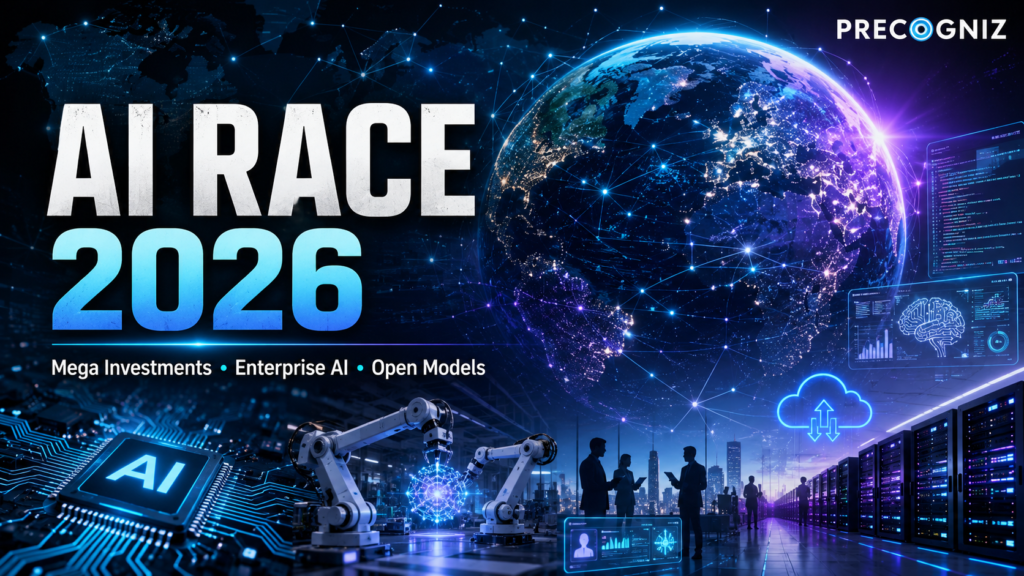
Several major announcements this week demonstrate that the AI race is no longer about launching another chatbot. Instead, the focus has shifted toward building massive computing infrastructure, releasing powerful open-weight foundation models, preparing billion-dollar public offerings, and creating enterprise-grade AI systems capable of transforming entire industries.
For businesses, developers, policymakers, and technology leaders, these developments provide valuable insight into where AI is heading over the next decade. This article examines the most important AI stories of the week, their broader implications, and why they matter for organizations worldwide.
The AI Industry Enters a New Phase
During the first wave of generative AI, the primary focus was on creating chatbots capable of answering questions and generating content. Today, the industry has entered a much more sophisticated phase.
Modern AI systems are increasingly expected to:
- Perform complex reasoning
- Execute multi-step workflows
- Operate autonomously
- Integrate with enterprise software
- Assist scientific research
- Improve business decision-making
- Automate software development
This shift is changing how companies allocate resources. Instead of investing only in AI applications, organizations are now investing heavily in the underlying infrastructure required to train and deploy increasingly capable models.
Thinking Machines Lab Releases Inkling
One of the week’s most significant announcements comes from Thinking Machines Lab, which introduced Inkling, a 975-billion-parameter open-weights AI model released under the Apache 2.0 license. This represents one of the largest openly available AI models announced in recent months and reflects the growing momentum behind open AI ecosystems.
Unlike closed proprietary models, open-weight models enable developers, researchers, startups, and enterprises to inspect, fine-tune, and deploy AI systems with greater flexibility. This approach lowers barriers to innovation and encourages broader experimentation across industries.
The release of Inkling reinforces an important industry trend: organizations increasingly value transparency, customization, and deployment flexibility alongside raw model performance.
Enterprise AI Becomes the New Battleground
The competitive landscape has evolved significantly.
Rather than competing solely on benchmark scores, AI companies are now differentiating themselves through enterprise capabilities such as:
- Large context windows
- Agentic workflows
- Lower inference costs
- Improved reasoning
- Enhanced security
- On-premises deployment
- Regulatory compliance
Enterprise customers require AI solutions that integrate seamlessly with existing business processes while meeting strict governance and security standards. As a result, vendors are investing heavily in infrastructure, orchestration tools, and enterprise-grade deployment options.
This marks a major shift from consumer-focused AI toward comprehensive business transformation platforms.
OpenAI, Anthropic, and the Race Toward Public Markets
Another notable development involves the financial evolution of leading AI companies.
Reports indicate that Anthropic is accelerating preparations for a potential public offering, while OpenAI is also considering its long-term IPO strategy. These developments reflect the enormous capital requirements associated with frontier AI research and deployment.
Training next-generation foundation models requires billions of dollars in computing infrastructure, specialized AI chips, engineering talent, and global data center capacity.
Going public could provide AI companies with access to additional capital while increasing transparency and accountability for investors.
The potential IPOs also demonstrate growing confidence that AI has transitioned from an emerging technology into a foundational industry expected to influence every sector of the global economy.
The Rise of Open AI Ecosystems
One of the defining themes of 2026 is the rapid growth of open AI ecosystems.
Organizations increasingly recognize several advantages of open-weight models:
- Greater transparency
- Reduced vendor lock-in
- Lower operational costs
- Better customization
- Faster research collaboration
- Enhanced security auditing
This trend benefits startups, universities, governments, and enterprises seeking greater control over AI deployments.
Rather than depending entirely on proprietary APIs, many organizations are building internal AI platforms using customizable open models tailored to specific business requirements.
AI Infrastructure Is Becoming Strategic
Behind every advanced AI model lies an enormous amount of computing infrastructure.
Training trillion-parameter models requires:
- Massive GPU clusters
- High-speed networking
- Efficient cooling systems
- Specialized storage
- Advanced orchestration software
- Energy optimization
Technology companies are therefore investing unprecedented amounts into AI infrastructure.
Industry analysts estimate that global spending on AI infrastructure will continue growing rapidly over the next several years as organizations compete to build increasingly capable foundation models.
This infrastructure race may ultimately prove more important than the models themselves, as computational capacity becomes one of the primary competitive advantages in AI development.
AI Agents Are Redefining Productivity
Another important trend is the emergence of AI agents.
Unlike traditional chatbots, AI agents can:
- Plan tasks
- Execute workflows
- Interact with software
- Use external tools
- Analyze documents
- Generate reports
- Perform iterative reasoning
This represents a major leap from simple conversational AI toward autonomous digital assistants capable of completing meaningful business work with minimal supervision.
As AI agents mature, organizations are expected to redesign many operational workflows around human-AI collaboration rather than simple automation.
DeepSeek’s Growing Global Influence
Chinese AI startup DeepSeek continues to strengthen its position in the global AI landscape. Over the past week, reports indicated that the company is preparing for a major public offering while simultaneously raising additional private capital to support its next generation of AI models and cloud infrastructure. The company is reportedly targeting a significantly higher valuation while expanding enterprise adoption of its AI platform.
Unlike many competitors, DeepSeek has focused on delivering high-performance AI models at competitive pricing. This strategy has attracted developers, startups, and enterprises looking for cost-effective alternatives to premium AI services.
The company’s rapid growth also reflects the increasing maturity of China’s AI ecosystem. While U.S. companies continue to dominate frontier AI research, Chinese firms are demonstrating that innovation is becoming increasingly global rather than concentrated in a single region.
For businesses, this means greater competition, faster innovation, and more choices when selecting AI technologies.
Infrastructure Has Become the Real AI Battleground
A major trend shaping 2026 is the realization that success in AI depends not only on developing powerful models but also on building the infrastructure capable of training and operating them.
Leading technology companies are investing hundreds of billions of dollars in:
- AI data centers
- Specialized GPU clusters
- High-speed networking
- Advanced cooling systems
- Energy-efficient computing
- Dedicated AI chips
This infrastructure race has become one of the defining characteristics of the AI industry. Companies that can scale computing resources efficiently are better positioned to train larger models, reduce inference costs, and deliver faster AI services to customers.
As AI adoption expands across industries, infrastructure will likely remain one of the strongest competitive advantages for technology leaders.
AI Regulation Moves from Discussion to Implementation
Artificial intelligence is no longer viewed solely as a technological innovation—it has become a matter of economic competitiveness, national security, and public policy.
Governments around the world are introducing regulations that address:
- AI transparency
- Model accountability
- Data privacy
- Copyright protection
- Cybersecurity
- Safety testing
- Responsible deployment
Technology companies are responding by investing more heavily in AI governance frameworks and compliance tools.
For enterprises, regulatory readiness is becoming just as important as model performance. Organizations adopting AI should establish governance policies covering data quality, security, human oversight, and risk management.
Businesses that prepare early will be better positioned to adapt as regulations continue to evolve.
Enterprise AI Adoption Continues to Accelerate
The conversation around AI has shifted from experimentation to measurable business value.
Organizations across sectors—including banking, healthcare, manufacturing, telecommunications, retail, logistics, and government—are integrating AI into daily operations.
Common enterprise use cases include:
- Customer support automation
- Intelligent document processing
- Financial forecasting
- Fraud detection
- Predictive maintenance
- Software development assistance
- Risk management
- Knowledge management
- Marketing content generation
Rather than replacing employees, successful implementations increasingly focus on augmenting human capabilities by automating repetitive tasks and enabling faster decision-making.
AI and the Future Workforce
One of the most frequently discussed topics remains AI’s impact on employment.
While certain repetitive tasks are becoming increasingly automated, new opportunities are emerging in areas such as:
- AI engineering
- Prompt engineering
- AI governance
- Data quality management
- AI security
- Model evaluation
- Human-AI collaboration
- AI operations (AIOps)
Professionals who combine domain expertise with AI literacy are likely to be among the most sought-after talent over the next decade.
Organizations should therefore prioritize continuous learning and workforce upskilling to ensure employees can work effectively alongside intelligent systems.
Why Businesses Must Develop an AI Strategy Now
Artificial intelligence is no longer optional for organizations seeking long-term competitiveness.
Business leaders should focus on five strategic priorities:
1. Define High-Impact Use Cases
Identify processes where AI can improve productivity, reduce costs, or enhance customer experience.
2. Invest in Data Readiness
Reliable, well-governed data remains the foundation of successful AI implementations.
3. Build Responsible AI Governance
Establish policies covering ethics, security, privacy, transparency, and regulatory compliance.
4. Upskill Employees
Provide ongoing AI training to help teams adopt new technologies confidently.
5. Start Small and Scale Gradually
Pilot projects allow organizations to validate business value before expanding AI initiatives across the enterprise.
Key AI Trends to Watch Through 2027
Looking ahead, several trends are expected to shape the next phase of AI innovation:
Agentic AI
Autonomous AI systems capable of planning, reasoning, and executing complex workflows will become increasingly common.
Multimodal Intelligence
Future models will seamlessly process text, images, audio, video, and structured data within unified workflows.
Smaller Specialized Models
Compact domain-specific models will offer faster, more cost-effective deployment for enterprise applications.
AI at the Edge
Running AI directly on devices will improve privacy, reduce latency, and enable real-time decision-making.
AI Governance Platforms
Demand for governance, auditing, monitoring, and compliance solutions will continue growing alongside enterprise AI adoption.
Expert Perspective
The AI industry is entering a period of sustained transformation.
Recent developments demonstrate that competition is no longer centered solely on releasing the next chatbot. Instead, success increasingly depends on infrastructure investment, enterprise adoption, governance, and the ability to translate AI research into practical business outcomes.
Organizations that embrace AI strategically—while maintaining strong governance and investing in workforce development—will be best positioned to capitalize on the opportunities ahead.
Although challenges remain, including regulation, security, and ethical considerations, the pace of innovation shows no signs of slowing. Artificial intelligence is rapidly becoming foundational infrastructure for the digital economy.
Frequently Asked Questions
What was the biggest AI news this week?
Among the week’s notable developments were DeepSeek’s reported IPO preparations, continued infrastructure investments across the AI industry, and growing enterprise adoption of large language models.
Why is AI infrastructure so important?
Advanced AI models require enormous computing resources for both training and deployment. Companies with strong infrastructure can deliver faster, more scalable, and cost-effective AI services.
Will AI replace human jobs?
AI is expected to automate certain repetitive tasks while creating new opportunities in AI engineering, governance, security, and human-AI collaboration.
Why should businesses invest in AI now?
Early adopters can improve productivity, reduce operational costs, enhance customer experiences, and gain competitive advantages before AI becomes a standard capability across industries.
Conclusion
The developments of July 2026 reinforce a clear message: artificial intelligence is transitioning from a disruptive technology into a foundational layer of modern business and society. Competition among AI leaders is driving rapid innovation in infrastructure, enterprise applications, governance, and open ecosystems. For organizations, the challenge is no longer whether to adopt AI, but how to do so responsibly and strategically.
Businesses that invest today in AI capabilities, workforce skills, and governance frameworks will be better prepared to navigate an increasingly AI-driven future. As new models, infrastructure, and regulations continue to emerge, staying informed and adaptable will be essential for maintaining a competitive edge.